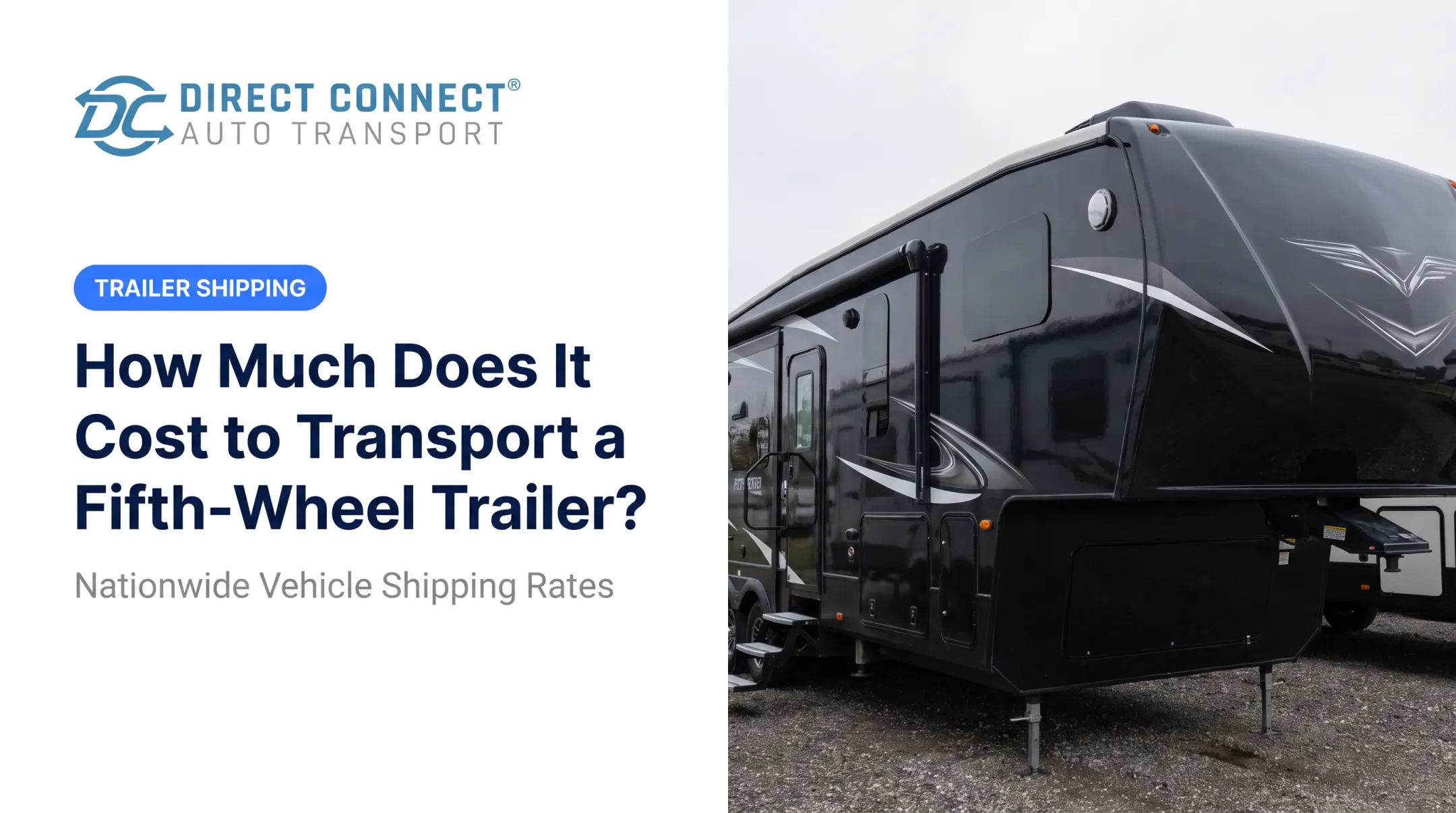
Many RV owners budget by multiplying miles by a generic per-mile figure they found online. That math falls apart fast once minimum dispatch charges, permits, deadhead miles, or a tricky driveway enter the picture. This guide breaks down how RV transport pricing actually works, the factors that move the needle most, what a quote should include, and how to compare offers without getting burned by a number that looked good on paper.
Key Takeaways
- RV transport rates vary by distance, RV type, transport method, season, and carrier availability; no single nationwide rate applies.
- Short-distance moves cost more per mile because loading, dispatch, and inspection fees spread across fewer miles.
- Larger, heavier, taller, or non-running RVs need specialized equipment and draw higher quotes than standard towables.
- The cheapest quote isn't automatically the best deal; weigh insurance, included services, and cancellation terms too.
- Flexible dates and accurate measurements help keep your final invoice close to your original estimate.
How Much Does RV Transport Cost?
RV transport doesn't come with a fixed price list. A quote typically has three layers:
- Base rate: the core charge tied to mileage, RV specs, and transport method
- Total transport charge: the base rate plus any route-specific add-ons known at booking
- Additional service fees: costs that only apply under certain conditions, like storage or expedited handling
There isn't a single, verified national per-mile benchmark that applies evenly across short, regional, long-distance, and cross-country RV moves. Rates from carriers and brokers vary widely based on RV type, route difficulty, and carrier capacity in your area.
Anyone quoting a flat "industry average" rate per mile is oversimplifying.
That's why companies like Direct Connect Auto Transport build RV quotes around the specific vehicle and route rather than a generic formula. A small travel trailer, a mid-size fifth wheel, a drivable Class A motorhome, and an oversized unit requiring permits will each land in a different pricing bracket, sometimes a significantly different one, even over identical mileage.
Why shorter routes often cost more per mile
A 200-mile move can carry a higher per-mile rate than a 2,000-mile one. Here's why:
- Loading, securing, and inspecting an RV takes roughly the same amount of time regardless of distance
- Dispatch and driver labor costs get spread across fewer paid miles on short hauls
- Carriers often have to reposition (drive empty, or "deadhead") to reach a short pickup, and that mileage isn't free for them
Federal rules under FMCSA's inspection rules require carriers to thoroughly inspect towing connections and brake function before a driveaway-towaway move, and to inspect towbars again afterward. That work takes time whether you're moving ten miles or a thousand, which is part of why short hauls rarely feel like a bargain on a per-mile basis.
A simple way to estimate
Say a carrier quotes a per-mile range for your specific RV and a 1,200-mile route. Multiply the low and high end of that range by your mileage to get a starting estimate. Then ask what that figure includes.
If your RV needs a special permit for width or height, or if the pickup driveway is too tight for a standard rig, expect that initial number to climb. A published rate range may or may not include fuel, tolls, permits, storage, or expedited service, so always ask before you compare two quotes side by side.

Key Factors That Affect RV Transport Rates
Distance, route, and accessibility
Total mileage drives your overall cost, but route density drives your rate per mile. A move along a busy interstate corridor is usually easier to price and staff than a route into a rural area with limited carrier traffic.
Other route-specific cost drivers include:
- Toll roads and mountain passes that add time and fuel
- Weather-prone regions that can delay pickup or delivery
- Narrow roads, low clearances, or steep driveways that block a standard rig
- The option to meet your carrier at a nearby, more accessible loading point instead
RV type, dimensions, and weight
Not all RVs load the same way. Travel trailers and fifth wheels typically tow behind a carrier's truck, while camper vans and motorhomes (Class A, B, or C) may drive onto a trailer or move via drive-away service.
Length, width, height, gross weight, tongue weight, and axle configuration all affect which equipment a carrier can use, which routes are legal, and whether a permit is required.
For reference, WSDOT's vehicle guide sets Washington's standard legal width at 8 feet 6 inches and height at 14 feet. Anything beyond those thresholds generally needs a permit. Every state sets its own limits, so your RV's exact dimensions matter route by route.
When measuring your RV, include anything that sticks out:
- Roof-mounted AC units, antennas, or solar panels
- Ladders, awnings, and cargo racks
- Spare tires and slide-outs when extended
Leaving these off your quote request is one of the most common reasons a price changes after booking.
Transport method and RV condition
RV carriers generally use one of a few methods:
- Tow-away transport: the RV is towed behind the carrier's truck, common for trailers and fifth wheels
- Drive-away service: a driver operates the motorhome under its own power for part or all of the route
- Flatbed or step-deck hauling: used for non-running units or RVs that can't be safely towed or driven
An RV that rolls, steers, and brakes normally is far simpler to load than one that doesn't. A non-running unit often needs a winch, lift, or extra labor, which adds to the quote.
If you're shipping a high-value RV, ask whether enclosed or additional protective transport is available for your RV type. It's not universally offered the way it is for cars, so confirm before assuming.

Season, demand, and delivery urgency
RV travel has clear seasonal swings. RVIA's winter survey found that roughly 28 million Americans planned winter RV travel in 2025, a 33% jump from the prior year. That kind of travel surge doesn't directly measure shipping demand, but it's a reasonable signal that carrier schedules get tighter around snowbird season and major holidays.
If you need guaranteed pickup or delivery by a specific date, that's a different service than a general estimated window, and it usually costs more. Ask your provider to spell out which one you're actually booking.
Fuel, permits, insurance, and carrier availability
Fuel prices shift carrier pricing over time, and oversized RVs may require permits, escorts, or both depending on the state. Insurance is another area worth scrutinizing closely.
Under FMCSA's insurance rules, for-hire property carriers must carry public liability coverage of $300,000 to $750,000 depending on vehicle weight, while brokers are required to hold a $75,000 bond or trust fund instead. These are regulatory minimums, not a guarantee of what your specific RV's cargo coverage looks like.
Don't assume every shipment automatically includes identical protection. Ask your carrier or broker directly what's covered.
RV Transport Cost Breakdown and Service Options
The advertised per-mile rate rarely represents everything on your final invoice. Here's what typically shows up on a full breakdown.
Initial transport charge
This is your base charge, reflecting route mileage, RV specs, transport method, and current market conditions. Confirm upfront whether your quote is all-in or subject to adjustment once the carrier physically assesses your RV.
Pickup, loading, and delivery
This covers door-to-door coordination, loading, unloading, and inspection paperwork. Direct Connect Auto Transport's RV service, for example, picks up at your specified address and delivers directly to your destination, with no terminal drop-off required.

Access limitations at either end can still require extra handling.
Fuel, tolls, permits, and escorts
Some providers roll these into an all-inclusive quote; others list them separately, especially for oversized RVs needing a permit or pilot escort. Ask which model you're getting before comparing two offers.
Storage, waiting, and expedited service
These are conditional charges that only apply in certain situations:
- Storage if your RV can't be delivered immediately
- Driver waiting time for missed appointments
- Re-delivery fees after a failed attempt
- Expedited scheduling for rush timelines
Specialty or oversized handling
Unusually large or heavy RVs often need specialist route planning. Direct Connect's DC Heavy Haul division handles oversized vehicle logistics as part of the company's broader transport network, though pricing and capability still depend on your specific RV's specs.
Comparing transport options by value
Lower-cost choices generally involve:
- Flexible scheduling
- Accessible pickup and delivery points
- Standard tow-away service
- Routes with strong carrier availability
Higher-cost choices typically involve:
- Expedited scheduling
- Difficult access points
- Flatbed or specialized equipment
- Non-operational loading or oversized permits
A cheaper quote isn't automatically the better deal. Weigh it against insurance terms, suitability for your RV, communication quality, and the risk of a surcharge appearing later.
How to Estimate Your RV Transport Budget and Avoid Surprise Fees
A workable starting formula looks like this: route miles × a realistic rate per mile for your RV type, plus any fixed, access, permit, equipment, or storage charges that apply. Treat this as a planning tool, not a binding number.
Gather the information needed for an accurate quote
Before requesting quotes, have this ready:
- Pickup and delivery ZIP codes
- RV type, year, and model
- Exact length, width, height, and weight
- Running condition and hitch details
- Photos of the RV
- Desired pickup/delivery dates
- Any access restrictions at either location
Direct Connect's RV quote form, for instance, specifically asks whether the vehicle is running, because that single detail changes which equipment a carrier dispatches. Inaccurate measurements, undisclosed damage, a dead battery, or a steep driveway can all change your price after booking.
Compare quotes on more than the headline rate
Request itemized, written quotes that spell out:
- Whether you're working with a carrier or a broker
- Transport method and insurance terms
- What's included in pickup and delivery
- Payment schedule and cancellation rules
- Conditions that could change the price later
Compare several qualified providers. An unusually low quote should prompt more questions, not an instant booking. Direct Connect has noted that bargain-bin pricing in this industry is sometimes tied to damage, lost items, or theft risk, which is worth keeping in mind before chasing the lowest number.
Ways to reduce the total cost
- Keep pickup dates flexible
- Book before peak season rather than during it
- Choose an accessible meeting point instead of a tight driveway
- Make the RV road-ready (charged battery, inflated tires)
- Remove personal belongings before pickup
- Skip expedited service unless genuinely necessary
Use a transparent quote process
A route-specific, itemized quote beats a generic online number every time. Direct Connect Auto Transport builds its RV quotes around your actual itinerary rather than a one-size-fits-all rate, which is a reasonable next step once you have your RV's specs and shipment details ready.
What most people miss about RV transport pricing
- Focusing only on the advertised per-mile figure hides minimum charges, deadhead mileage, and permit costs
- Picking a rate before confirming the correct transport method can lead to rebooking or delays
- Insurance language needs a close read: know what the carrier's policy covers and whether your high-value RV needs extra protection
- A quote with clear communication, tracking updates, and documented inspections often beats a lower, vaguer one in the long run
Conclusion
RV transport rates per mile are a useful starting point for budgeting, but they're never the whole story. Your final cost depends on several variables:
- Distance and route difficulty
- RV dimensions, weight, and running condition
- Transport method and timing
- Services included in the quote
Get an itemized quote built around your RV's real specifications, and judge it on suitability, coverage, and communication, not just the lowest number on the page. When you're ready, request a route-specific estimate from Direct Connect Auto Transport or another qualified U.S. RV transport provider.
Frequently Asked Questions
How much does it cost to transport an RV per mile?
Rates vary by distance, RV type, transport method, condition, route, and demand, so there's no single universal figure. A shipment-specific quote from a provider like Direct Connect Auto Transport is the only way to confirm your actual price.
Is RV transport worth it?
Professional transport saves you the fuel, mileage, and wear of driving a large or non-operational unit yourself, plus the time and safety concerns of towing an unfamiliar rig long distance. For many owners, that trade-off is worth the cost, especially on cross-country moves.
What is it called to pay someone to move an RV?
Common terms include RV transport, RV hauling, tow-away service, drive-away service, and flatbed transport. The right term depends on your RV type and whether it's towed, driven, or hauled on a trailer.
What factors affect RV transport rates?
Route distance, RV size and weight, transport method, running condition, season, fuel costs, permits, access difficulty, urgency, insurance, and carrier availability all play a role in your final price.
Are short-distance RV moves more expensive per mile?
Often, yes. Loading, dispatch, inspection, and repositioning costs get spread across fewer paid miles on short hauls, even though your total bill is usually lower than a long-distance move.