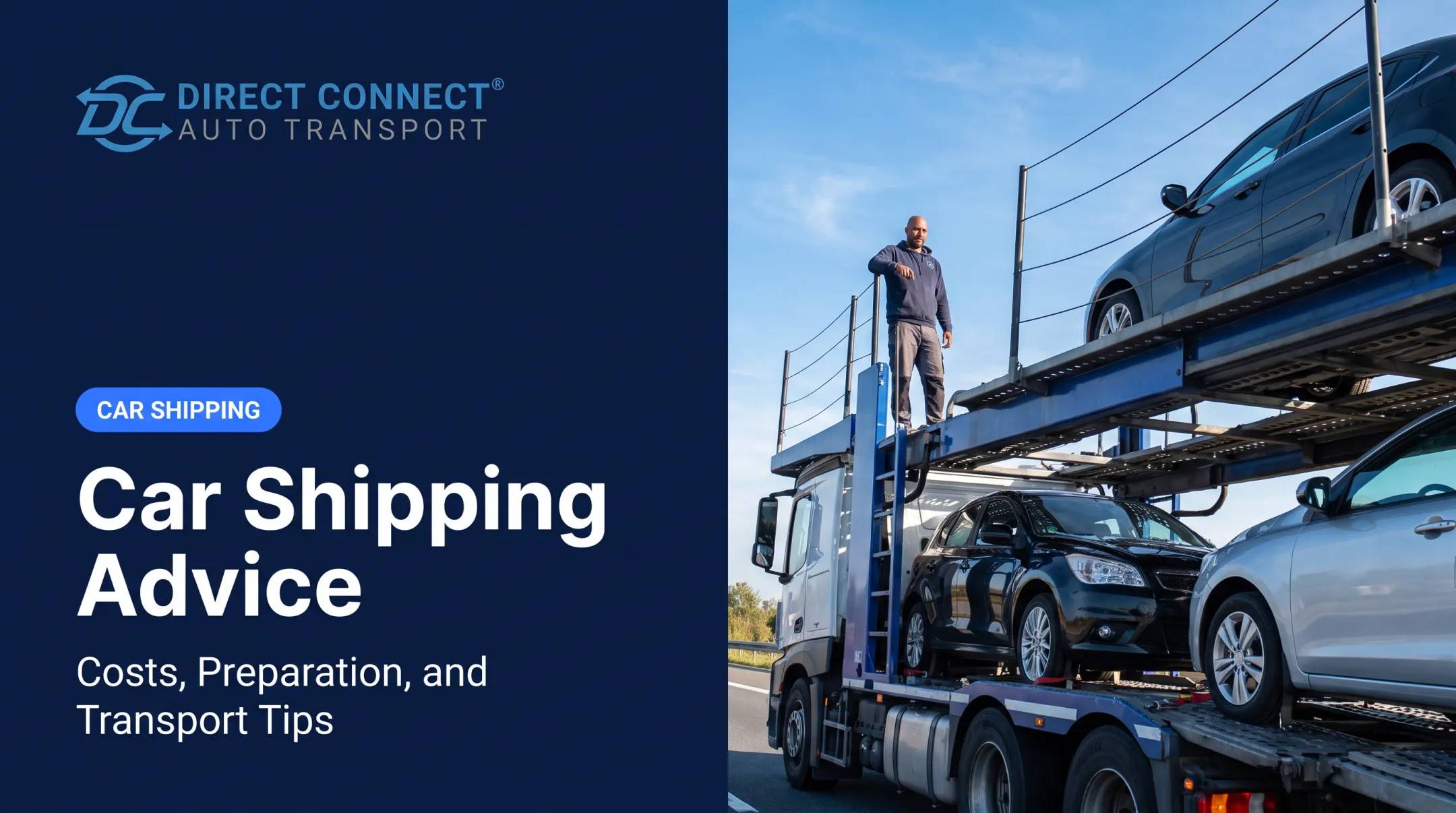
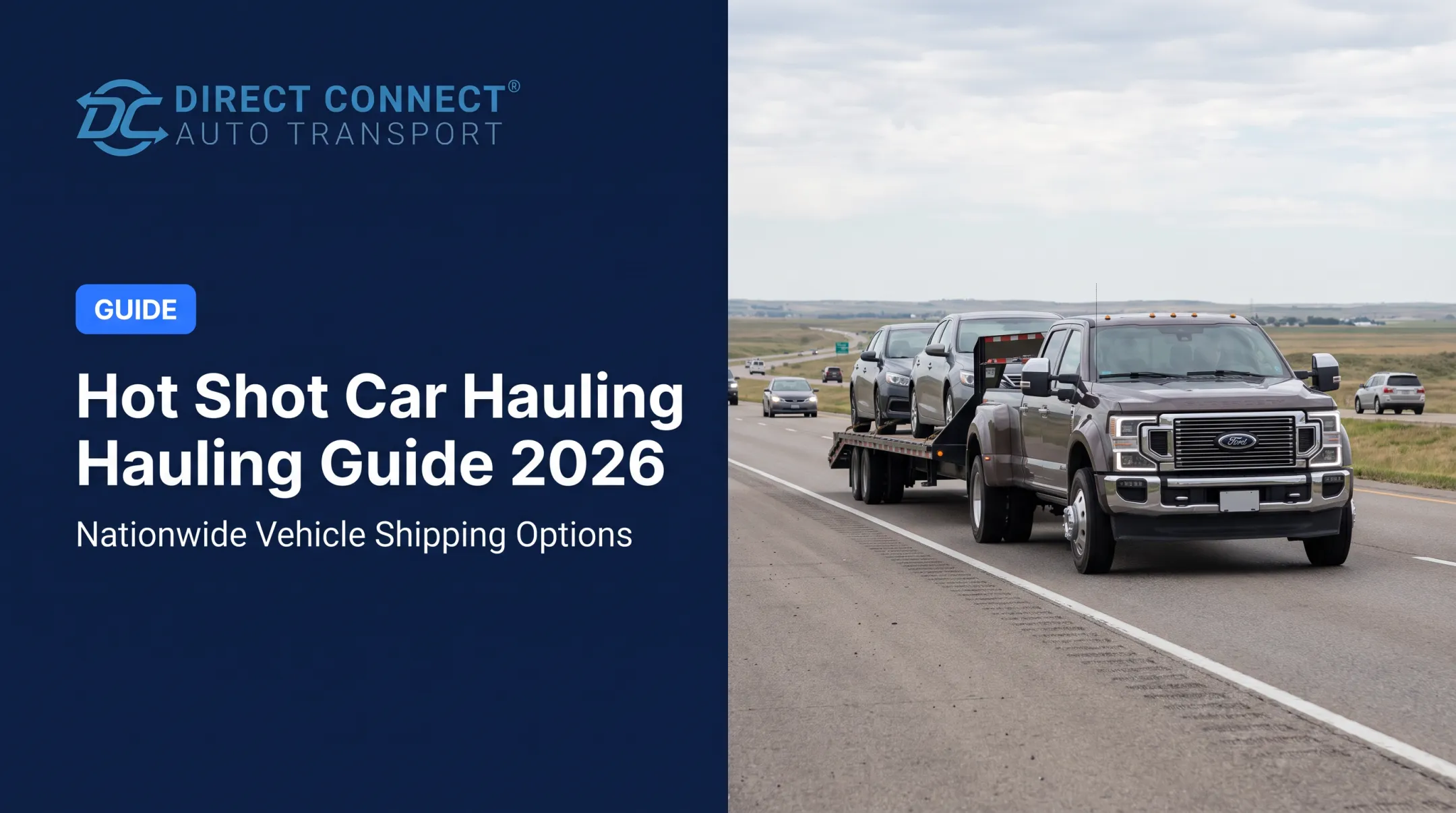
The equipment you pick affects loading, weather exposure, securement, delivery access, timing and price. Below, we compare flatbeds, conventional open carriers, enclosed trailers and heavy-haul equipment. Flatbeds offer flexibility, but the vehicle sits exposed to weather and needs the right equipment and professional securement.
Key Takeaways
- Open flatbeds give direct loading access for vehicles that don't fit standard carriers.
- Dimensions, weight, condition, modifications, and site access decide the right trailer.
- Flatbeds are versatile but protect less than enclosed transport.
- Get a written quote covering equipment, securement, insurance, pickup, delivery, and permits.
What Is Open Flatbed Vehicle Transport?
An open flatbed setup is an uncovered, level deck with no permanent sides or roof. FHWA's glossary defines a flatbed trailer as a trailer without sides used for hauling machinery or other bulky items. Vehicles load from the rear or side, or with ramps and winches.
Flatbed vs. conventional open carrier
A conventional open carrier is a multi-deck hauler built for several operable passenger vehicles. Cottrell's CX-6MST, for example, is specified for 9 or 10 vehicles, depending on the combination. A flatbed is usually chosen for one vehicle, or a load that needs more flexible loading and securement.
Terms worth knowing
- Flatbed trailer: open, level deck.
- Step-deck: short raised front deck, longer lower main deck.
- Lowboy: a deck lower than a standard flatbed, for taller loads.
- Truck vs. trailer: the truck tows; the trailer carries the vehicle.
When a flatbed makes sense
- Non-running or damaged vehicles
- Lifted or lowered vehicles
- Oversized trucks or RVs
- Vehicles with unusual dimensions
The tradeoff is exposure. Rain, dust, road debris, sun and public view all reach the vehicle in transit.
Open Flatbed Transport Options
Standard open flatbed
A standard flatbed carries a vehicle directly on a level deck, provided dimensions and weight stay within the equipment's rated and legal limits. Providers may load with ramps or a winch for inoperable vehicles. Winch availability varies by trailer, so confirm loading capability before booking.

Step-deck or drop-deck
A step-deck's lower rear deck helps with taller vehicles such as tall trucks, agricultural equipment or construction vehicles. Deck heights differ by model. Fontaine lists a 36-inch loaded height for one low-height drop-deck, so ask which trailer is assigned rather than assuming.
Lowboy, RGN and heavy-haul
Lowboys and removable gooseneck (RGN) trailers suit especially tall, heavy or oversized vehicles. Talbert's 55SA lowboy lists a 20-inch loaded deck height. These loads often require:
- Permits and route planning
- Escorts for some loads
- Weight distribution
- Specialized loading
Ask whether the carrier or the transport provider handles these.
Conventional open or enclosed carriers
For an ordinary running car, a conventional open carrier is usually the practical choice. Enclosed carriers suit classic, collector, exotic, restored or high-value vehicles. The final call depends on protection needs, condition, equipment availability, route and budget.
Match the equipment to the vehicle
| Vehicle | Likely fit |
|---|---|
| Running sedan | Conventional open carrier |
| Non-running lowered car | Winch-equipped flatbed |
| Tall or oversized truck | Step-deck or heavy-haul setup |
| Valuable restored car | Enclosed transport |
Benefits and Considerations of Open Flatbed Vehicle Transport
Easier loading and unloading
The open design allows rear, side, ramp, crane or winch access. That helps when a vehicle can't run or the site lacks a standard loading area.
Loading still depends on ground clearance, wheels, steering, brakes and battery, so give the provider accurate condition details before dispatch. Non-running vehicles need advance notice, and winching can add roughly $150 to $300.
Flexibility for unusual vehicles
With no roof or fixed sides, a flatbed can take loads too tall, wide, long or irregular for other carriers. But "fits on a flatbed" doesn't mean "legal to haul."
Federal rules set a 102-inch width on the National Network and ordinarily 80,000 lb gross weight on the Interstate System. FHWA notes there is no federal height requirement for commercial vehicles, and most states cap height at 13 ft 6 in to 14 ft.

Weather and road-debris exposure
An uncovered deck faces rain, snow, dust, sun, exhaust residue and debris. Tarps may reduce exposure but don't match an enclosed trailer. If finish protection is a priority, choose enclosed. Enclosed transport typically adds 40 to 60% to base cost.
Securement and handling
Professionals use wheel straps, approved tie-downs, chains where appropriate, edge protection, ramps and winches.
Federal rules are vehicle-specific: 49 CFR 393.128 requires at least two tiedowns for automobiles, light trucks and vans of 10,000 lb or less, and heavier vehicles fall under 393.130. Before departure, check:
- Securement points and working-load limits
- Wheel and bodywork protection
- A documented condition inspection
Legal and route considerations
States administer oversize and overweight permits, and the rules differ. Texas, Florida and California each set their own permit, escort and travel conditions. Permits, route surveys, escorts and delivery-site access can affect both timing and price.
Pricing and scheduling
Quotes depend on:
- Origin, destination and distance
- Vehicle dimensions, weight and condition
- Loading method and trailer type
- Season, urgency and route demand
- Permits and site accessibility
Compare complete written quotes, not just the lowest price. Each should name the transport type, included services, estimated timing, damage-claim process, payment terms and possible extra charges. Low-ball quotes can hide surprise fees.
How to Choose, Prepare for, and Book Open Flatbed Transport
Gather vehicle and route details
Before requesting quotes, collect:
- Make, model, accurate height and width, and weight
- Modifications and ground clearance
- Whether it runs, brakes, rolls and steers
- Tire and brake condition, leaks and keys
- Access limits such as narrow roads, steep grades or low branches
Prepare the vehicle
- Remove valuables, toll transponders and the title
- Charge the battery and set tire pressure to spec
- Document or secure detachable parts
- Take date-stamped photos of every side, wheel, window and existing mark
Consumer Reports recommends photographing the vehicle before loading.
Vet the provider
Confirm whether you're dealing with a broker or a carrier. FMCSA's SAFER system lets you search by USDOT or MC number.
Minimums to verify:
- Property brokers: $75,000 in financial security
- Covered carriers: $750,000 public-liability minimum
Neither covers vehicle cargo, so ask about the damage-claim process directly.
Also ask about equipment assignment, securement approach, tracking, and what happens if the vehicle can't be safely accessed.
Direct Connect Auto Transport can help you compare open, enclosed and specialty options, request a quote, coordinate nationwide U.S. transport, and follow progress through tracking and communication tools.
What to verify at each stage
- Quote: confirm trailer type and loading method.
- Pickup contact: expect a call 24 to 48 hours ahead.
- Pickup inspection: review and sign the bill of lading.
- Loading: confirm securement suits your vehicle.
- Transit: watch updates; weather can change routes.
- Delivery: inspect against the bill of lading before signing.

Frequently Asked Questions
What is an open bed truck?
An open bed truck is a truck or trailer with an uncovered cargo platform. A flatbed vehicle carrier differs from a pickup bed and from a conventional open auto carrier.
What is the difference between a flatbed and a trailer?
A flatbed is one type of trailer. "Trailer" is the broader category, while a flatbed has an open, level deck with no fixed sides or roof.
When should I use open flatbed vehicle transport?
Consider it for inoperable, damaged, modified, tall, oversized or oddly shaped vehicles. Confirm loading access and legal requirements first.
Is open flatbed vehicle transport safe?
Safety depends on matching equipment, professional loading, compliant securement, accurate vehicle details, inspections and sound route planning.
Is a flatbed better than an enclosed carrier?
Neither wins outright. Flatbeds offer access and flexibility, while enclosed carriers better shield vehicles from weather, debris and public exposure.
How much does open flatbed vehicle transport cost?
Distance, size, weight, condition, equipment, permits, route, timing and access all drive price. Request a detailed written quote.