Plenty of owners get this wrong. They request a quote with vague details, then face a revised price or a no-show driver when the trailer turns out to be 9 feet tall or has a flat tire.
This guide covers tow-away versus flatbed transport, door-to-door versus terminal delivery, preparation, documentation, and how to get a quote that holds up.
Key Takeaways
- Match the transport method to the trailer's condition, size, weight, and running gear.
- Submit exact measurements, weight, photos, and access details before accepting a quote.
- Get written approval before leaving anything inside the trailer.
- Compare scope of service, insurance, extra charges, and pickup windows in writing.
Cargo Trailer Basics and Shipping Options
A cargo trailer is an enclosed, towable unit that protects and moves goods. It differs from an open utility trailer (no walls or roof), a car hauler, and an intermodal container chassis. Federal classification calls the body type a "Van / Enclosed Box", an enclosed body built into the trailer frame.
Two situations often get confused:
- Shipping the trailer: the trailer is the freight a carrier moves.
- Using the trailer: the trailer carries household goods, equipment, or motorcycles, and you tow it yourself or hire a mover.
This article covers the first.
Shipping Methods for Cargo Trailers
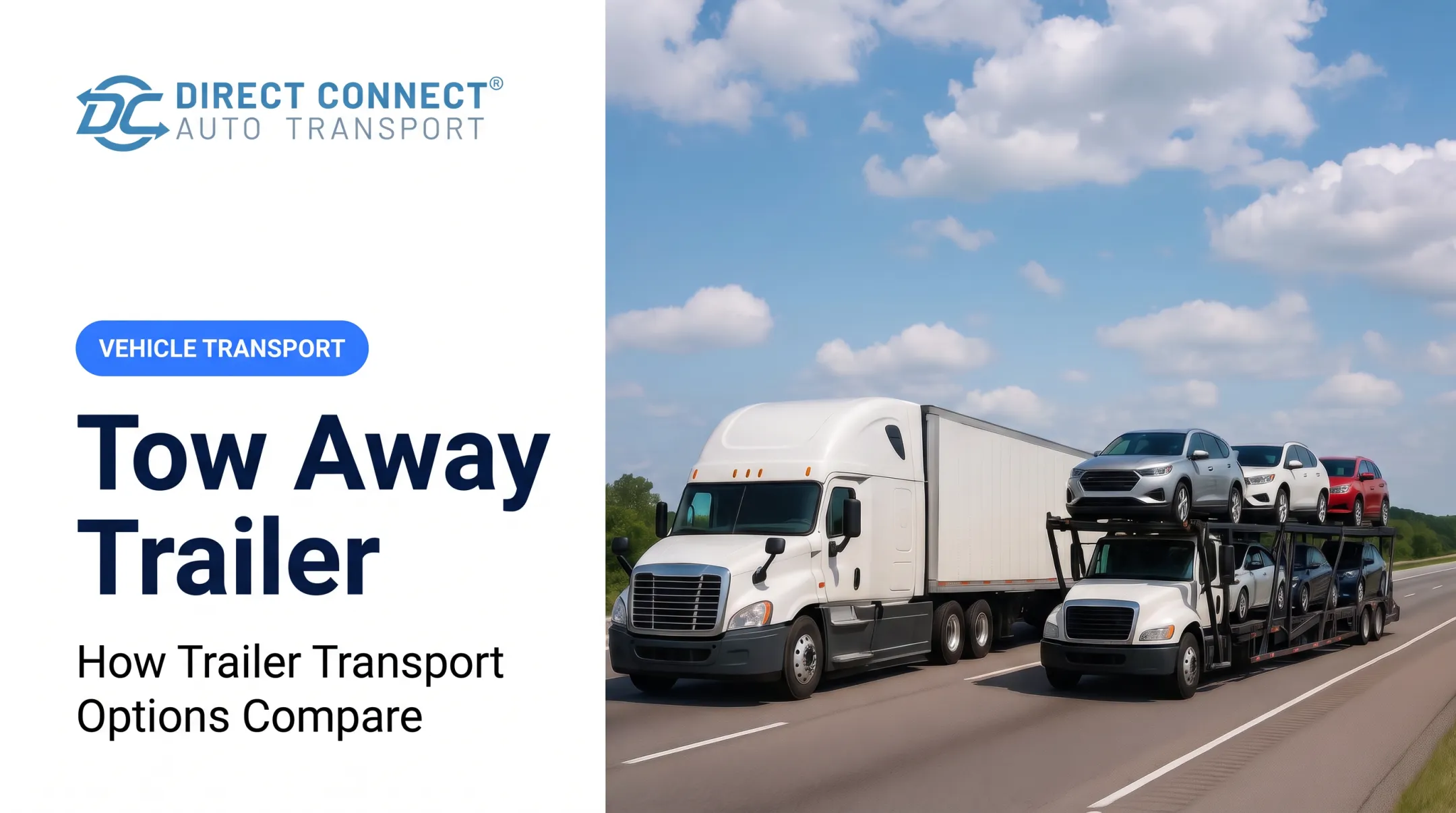
Tow-away works for roadworthy trailers. A truck hitches the trailer and pulls it. That requires a compatible coupler and working tires, wheels, axles, brakes, and lights. Confirm hitch type and ball size with the carrier before booking.
Flatbed or step-deck suits trailers that are inoperable, damaged, oversized, unusually heavy, or unsafe to tow. The trailer is loaded onto a deck. Loading equipment varies, so ask what the carrier brings and what the pickup site must provide.
Deck sizes differ by equipment. C.H. Robinson's guide lists a standard flatbed at 48 feet long with a 5-foot deck height, while a single-drop trailer has a lower main deck. These are equipment examples, not legal allowances for every route.

Delivery Options
- Door-to-door: Pickup and delivery as close to your address as the truck can safely get. Convenient, but access-dependent.
- Terminal-to-terminal: You drop off and collect at terminals. Often costs less, though you handle extra logistics and scheduling.
One more distinction: "enclosed cargo trailer" describes the trailer being shipped. "Enclosed transport" describes the carrier's equipment. An enclosed carrier may not fit every cargo-trailer size, so ask directly.
Cargo Trailer Transport Requirements
Trailer Measurements and Weight
Gather these before you request a quote:
- Overall length, width, and height
- Empty weight, and actual loaded weight if any
- GVWR (the manufacturer's rated loaded weight)
- Axle count
- Add-ons that change the exterior size, such as roof vents, spare-tire mounts, or ladder racks
Measure the extras. A 12-inch rooftop vent can push a trailer past a height threshold.
These numbers drive carrier selection, deck space, permits, route planning, loading gear, and price.
Federal rules set a 102-inch width limit on the National Network and no federal height limit, so states set height. Texas, for instance, treats loads over 8 ft 6 in wide or 14 ft tall as permit territory.
Roadworthiness and Condition
Tell the carrier everything:
- Does the trailer roll freely?
- Are tires and wheels usable?
- Do the hitch and coupler work?
- Do brakes, lights, axles, and suspension function?
Federal safety rules require at least 2/32 inch of tread with no exposed cords or leaks. Unsafe equipment cannot simply be towed. A trailer failing those checks may need flatbed service or repair first.
Vague descriptions backfire. Saying "runs fine" about a trailer with a seized axle leads to a carrier mismatch, a missed pickup, or a revised quote on the day.
Documentation, Contents, and Access
Paperwork. Expect requests for proof of ownership or authorization, title or registration details where applicable, ID, keys, and a signed bill of lading. Requirements vary by carrier and state. Texas, for example, requires a title for trailers over 4,000 lb, while New York titles trailers over 999 lb.
Contents. Loaded-trailer policies differ widely. Before leaving anything inside:
- Get written approval from the carrier.
- Remove hazardous or prohibited materials.
- Secure whatever is permitted.
- Disclose the added weight.
Access. Large trucks struggle with narrow roads, low clearances, steep driveways, gated properties, and tight turns. Commercial sites add their own rules. If a truck cannot safely reach you, arrange a nearby meeting spot such as a large parking lot.
Regulations and Permits
Oversize or overweight trailers may need state permits, set routes, escorts, or special equipment. Rules vary by state.
Texas requires one escort for permitted widths over 14 feet up to 16 feet. North Carolina requires a front escort on certain two-lane roads above 12 feet. Ask the carrier who handles each requirement, rather than assuming.

Exporting? That usually means a separate domestic leg to the port plus separate ocean freight. This article covers only the U.S. inland portion.
How to Prepare and Book a Shipment
Build an Information Packet
Pull together:
- Origin and destination addresses and preferred dates
- Exact measurements and weight
- Trailer identification details and condition notes
- Hitch and running-gear status
- Access restrictions
- Whether the unit will be empty
- Photos
Prepare the Trailer
- Remove unapproved contents and secure or remove loose equipment
- Check tires and wheels
- Protect doors and latches
- Confirm the jack and coupler position
- Keep keys or access instructions handy
Document Condition
Take date-stamped photos or video of:
- Every side and the roof
- Doors, tires, wheels, and hitch
- Interior, existing damage, and any included accessories
This builds your condition record. A damage note on a delivery receipt helps, but under federal claim rules it is not enough on its own to count as a formal claim. You still need a written claim with a specific amount.
Compare Quotes
The lowest price rarely tells the full story. Check what each quote includes:
- Pickup and loading
- Permits and fuel or route surcharges
- Storage and accessorial services
- Insurance
- Cancellation and delivery-change terms
Book and Dispatch
Confirm these details before you lock in the move:
- Carrier or equipment type
- Pickup window and contact details
- Payment terms and cancellation policy
Ask how updates work if weather, access, or mechanical problems change the schedule.

Pickup and Delivery Handoff
At pickup, walk the trailer with the driver. Record its condition on the bill of lading, list contents or accessories, and keep signed copies.
At delivery, inspect before signing final acceptance. Check:
- Exterior, doors, roof, and frame
- Tires, wheels, and lights
- Hitch and interior
Note any new damage on the bill of lading before you sign, photograph it, and report discrepancies promptly through the carrier's claims process. File within 24 hours to protect your claim.
Costs, Timelines, and Delivery Planning
What Drives Cost
- Route distance
- Trailer dimensions and weight
- Roadworthiness and transport method
- Permits
- Seasonal demand
- Pickup and delivery access
- Storage and special loading needs
These factors are why any generic price you see online is a guess. Route-specific quotes are more reliable. Public market data, such as DAT's flatbed spot rates, measure what brokers pay carriers, not what you pay, and they are not tow-away or enclosed-trailer prices.
Planning Transit Time
Separate the pickup window from loaded transit time. Route density, weather, permits, equipment availability, and access all shift the schedule. Permits can even dictate travel times and endpoints. Expedited requests usually cost more than standard scheduling. No honest provider promises a fixed delivery date.
Keeping Costs Down
- Share complete specs upfront, including size, weight, and condition
- Stay flexible on pickup and delivery dates
- Use a meeting point carriers can access easily
- Use terminals only if you can handle extra towing on either end
Choosing a Cargo Trailer Transport Provider
Before you book, run every provider through the same checklist and questions so you can compare equipment, coverage, and price on equal terms.
Vetting Checklist
- Experience with cargo trailers specifically
- Clear disclosure of whether they are a carrier or broker, and who does the hauling
- Insurance and claims procedures
- Written pricing
- Responsive communication, reviews, and tracking
You can look up any company by USDOT or MC number on FMCSA's SAFER system. Be wary of unusually low prices.
Questions to Ask Before Booking
- Can you move this trailer by tow-away or flatbed?
- What happens if it won't roll?
- Can it contain goods?
- Who handles permits?
- What equipment will load it?
- What access limits could change the handoff location?
Direct Connect Auto Transport
Direct Connect Auto Transport is worth a route-specific evaluation. Since 2001 it has coordinated domestic and specialty transport through a nationwide, carrier-managed network. Services include online quotes, vehicle tracking, and direct driver contact. Its DC Heavy Haul division, launched in 2024, handles heavy and oversized vehicles.
Cargo-trailer acceptance, equipment, coverage, and pricing must be confirmed for your individual unit.
Read the Protection Terms
Direct Connect's published guarantee refers to a "vehicle" arriving undamaged. Whether any guarantee, from any provider, covers a trailer, its contents, accessories, or pre-existing damage is something to get in writing.
Conclusion: Plan Your Cargo Trailer Transport With Confidence
Accurate specifications, honest condition details, suitable equipment, a documented handoff, and written service terms make for a smooth shipment.
Call Direct Connect Auto Transport at 800-980-2222 or request an online quote to discuss your route, trailer specifications, pickup access, transport method, tracking, and applicable coverage before booking. Quotes are guaranteed for 7 days.
Frequently Asked Questions
What is a cargo trailer?
An enclosed, towable trailer used to protect and carry goods, from household items to equipment. Unlike an open utility trailer, it has walls and a roof. It is also separate from the transport service used to ship it.
How do you transport a trailer?
Roadworthy trailers can be tow-away shipped behind a truck. Damaged, inoperable, oversized, or otherwise unsuitable units usually go on a flatbed or step-deck.
What is a cargo transport?
It is the movement of goods or equipment from one place to another. A cargo trailer may be the equipment carrying those goods, or it may be the item being shipped.
Can you ship a cargo trailer that is not roadworthy?
Often yes, but it may need a flatbed or specialized loading. Disclose tire, axle, brake, hitch, and frame problems before getting a quote.
What information is needed for a cargo trailer shipping quote?
Provide the route, dimensions, weight, condition, roadworthiness, photos, access restrictions, preferred dates, and whether the trailer will be empty or loaded.
Can I leave belongings inside a cargo trailer during transport?
Policies vary. Get written approval, remove hazardous or prohibited items, secure permitted contents, and disclose the added weight.